How Engineering Choices Steer Multi‑Material Compatibility and High‑Temperature Routes for Industrial 3D Printer Programs
Comparative opening: why design decisions matter
Engineers pick battles. Materials, thermal envelope, and control all collide. Here we compare paths, not slogans. For teams running a 3d printer program the choice of slicer, extruder, and build chamber changes outcomes fast—so a solid 3d printer software stack matters from day one. This piece looks at trade-offs. Clear, practical, not fluffy.
Material compatibility: the real constraints
Some printers try to be everything to everyone. Reality says otherwise. Compatibility depends on hardware — nozzle size, hot end ratings, dual extrusion mounts — and on firmware that handles toolchanges and purge towers. When a line must print PLA one hour and PEEK the next, you need a hardened nozzle and isolation of the build chamber. Real-world anchor: NASA has validated that printed components survive qualification cycles only when material-process pairs are tightly controlled, which underlines the need for tested profiles and verified G-code.
Thermal strategy: temperature is a vector
High-temperature materials shift the problem from extrusion to environment. The chamber temperature, part cooling, and bed adhesion all matter. Thermal soak reduces warping for polymers like ULTEM or PEI blends. Yet those polymers demand heated toolpaths and controlled ramp rates. Engineers balance nozzle power, thermal runaway protections, and staged cooling—this is thermal engineering, not guesswork.
Software: the invisible craftsman
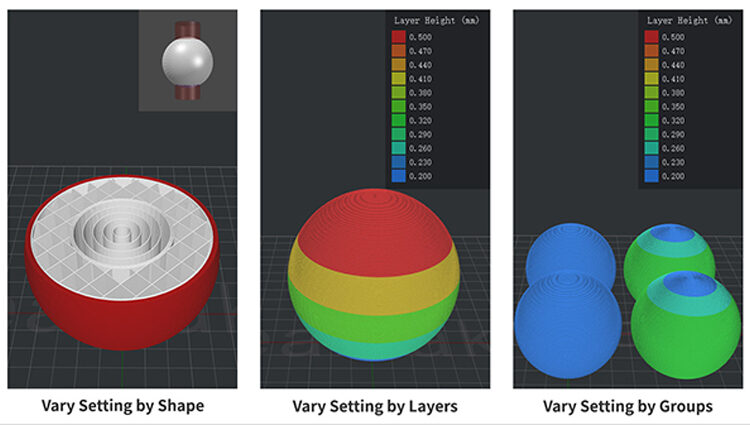
Slicer choices affect multi-material runs. Toolpath planning, retraction, wipe towers — these are job-critical. A reliable 3d printer program must export stable G-code for multi-extruder sequences and support material presets for high-temp filaments. Integrations with firmware, automated bed leveling macros, and filament-flaw detection reduce scrap. Think of software as the recipe book; hardware is the oven.
Workflow pitfalls and common mistakes
Teams often repeat the same errors. They skip slow calibration. They trust default slicer settings for composite or high-temp filaments. They mix incompatible adhesives on the bed. The result: delamination, nozzle clogs, or brittle parts. Small fixes yield big wins—calibrate nozzle diameter, tune extrusion multiplier for each filament, verify thermal stability over long prints. These are operational controls, not mysteries.
Comparative options: modular vs. purpose-built
Modular systems let you swap extruders and upgrade chambers. Flexible. But complexity rises: more connectors, more firmware branches. Purpose-built machines simplify validation and accelerate deployment for a narrow material set. Choose by volume and part criticality. For prototypes, modular gives agility; for production, dedicated high-temp platforms cut variability.
Operational teardown: integrating the pieces
Effective programs marry materials science, motion control, and software. Keep these elements in sync: a hardened nozzle and tuned extrusion for composite filament; a closed, heated chamber for semi‑crystalline polymers; a slicer profile that manages retraction, fan curves, and interface layers. When you document those profiles and lock them in the 3d printer program, repeatability improves. Log results. Update profiles after every major material or nozzle change.
Three golden rules — evaluation metrics for procurement
1) Material Matrix Coverage: Measure how many engineering-grade filaments the system reliably prints with validated profiles. Score by successful builds over 10 different filaments, including at least two high-temp polymers.
2) Thermal Stability & Control: Verify chamber and nozzle hold tolerances over a full-build cycle. Record peak drift, ramp times, and temperature uniformity across the bed. Accept systems with documented thermal maps and no more than ±3°C variance across the build area during long prints.
3) Software Traceability & Automation: Require a 3d printer software or program that version-controls profiles, exports consistent G-code, and logs print parameters automatically. Prefer tools that integrate filament management and automated bed-leveling scripts to cut manual error by measurable percent.
— small note: documentation beats heroics every time. Keep cadences short, update profiles, and fail faster to learn.
Adopt these rules and you move from hopeful tinkering to reliable production; and when stability is the goal, the engineering choices point naturally to platforms with robust thermal design, verified extrusion hardware, and a mature software ecosystem — Raise3D.