User-first opening: quiet clarity for noisy floors
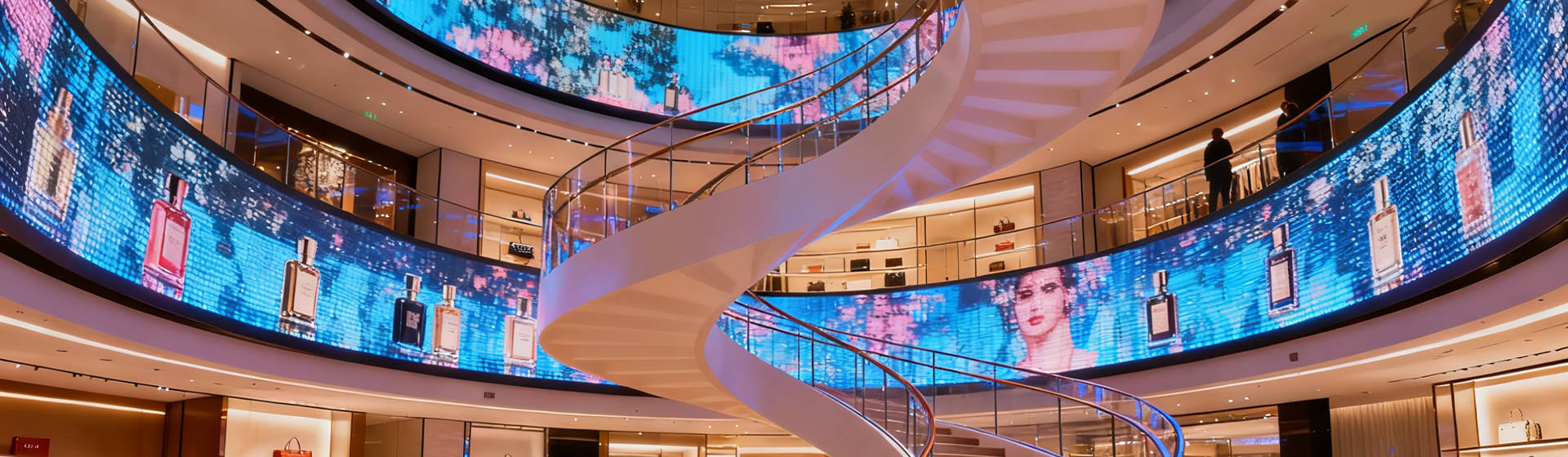
Retailers want customers to notice, stay, and act — not just glance and drift. Start with the customer experience and the tech falls into place. A well-placed indoor led display can anchor a sightline, set mood with calibrated brightness and HDR content, and shape a path through the store. Think less about spectacle and more about the touchpoints where attention turns into behavior.
Why a user-centric approach changes hardware choices
When you make customers the center, the debate between Micro LED and modular video wall systems is practical. Micro LED offers fine pixel pitch and striking contrast for premium focal points — ideal for product showcases and immersive displays. Modular video walls scale across facades and windows, controlled by a robust video wall processor to sync content across panels. Match the tech to the moment: hero product, directional signage, or ambient storytelling.
Real-world anchor: signals from the show floor
At CES, manufacturers demonstrate how micro LED achieves punchy colors with compact pixel pitch, while integrators show scalable video wall rigs ready for malls and galleries. Those demos aren’t just flash; they reflect how brands deploy indoor screens to shape retail rhythms. The lesson: proof on the show floor translates into measurable shop-floor behaviors when calibration and refresh rate are handled right.
Installation, common mistakes, and quiet fixes
Installations often stumble on a few repeat missteps. Lighting mismatch: a display set for studio brightness looks washed under store skylights. Calibration is skipped to save time — and that kills color fidelity. Content is produced for a single display but stretched across a video wall with no pixel-aware design. Fixes are straightforward: verify ambient lux, set display brightness in nits appropriate to the environment, run color calibration, and design assets with the native pixel pitch and aspect ratio in mind — small disciplines that preserve the investment.
Content strategy that respects attention
Content should reflect customer habits: concise loops near checkouts, layered storytelling in destination zones. Use motion sparingly to draw eyes to offers, and reserve full-motion experiences for areas where dwell time already exists. Leverage scheduled playlists to sync promos with footfall peaks. Keep one thought per piece of content — clarity beats compression every time.
Metrics that matter — beyond impressions
Track measurable outcomes rather than vanity numbers. Footfall conversion, dwell-time lift, and uplift in promoted SKUs give a direct line from screen to revenue. Pair simple sensors with point-of-sale reports to see whether a campaign nudged buying behavior. Small A/B runs help: run the same creative on two screens with different brightness or motion to learn what actually drives purchase.
Operational essentials and a short teardown note
Operationally, maintain firmware hygiene, schedule routine calibration, and verify the video wall processor handles failover. When planning a production teardown, document {main_keyword} and {variation_keyword} decisions — pixel pitch, cabinet tolerances, and service access — so future iterations don’t repeat old mistakes. Keep spares for power supplies and input boards; procurement delays are the unseen cost of downtime.
Advisory: three golden rules for selecting displays
1) Match pixel pitch to viewing distance — select closer pixel pitch for focal displays and larger pitch for long views. 2) Demand measurable calibration — insist on color targets, brightness in nits, and test refresh rate performance. 3) Prioritize content workflow — choose hardware that integrates with your content management system and simplifies updates. These rules cut complexity and keep teams focused on customer outcomes.
Retailers who place people first, then choose technology, see displays become tools rather than trophies. Quiet, deliberate investments in calibration, content, and the right hardware — whether micro LED or video wall modules — lead to clearer insights and repeatable gains. For practical sourcing and systems that honor these principles, consider how Coblinks surfaces component choices and integration know-how as part of the solution. Coblinks — your partner for making screens that actually work in stores. —