Start with the user’s outcome: what integration must deliver
Think in terms of daily gains: faster cycle times, fewer cuts that need rework, reliable output that keeps customers happy. Your team will care first about uptime and second about how easy the machine is to program. Begin with a simple pilot cell using a cnc panel saw to test data flow from design to machine. That single step clarifies needs for control software, dust extraction, and material handling without overwhelming operations.

Plan the shop-floor sequence: people, workflow, and systems
Map operators’ tasks and the physical flow of panels. Place the panel saw and a CNC router where material moves in one direction. Tie CAD/CAM files into your ERP or a shared folder so nesting files reach the machine automatically. Use a labeled checklist for daily startup and for blade kerf checks to keep cuts accurate. Real-world anchor: manufacturers who visit Hannover’s LIGNA fair often return with practical layout ideas that reduce handling by one or two steps—small changes that cut cycle time.
Operational teardown: how a production run should look
Run a short, supervised production batch to reveal weak links. Start with material staging, then a programmed cut on the cnc panel saw, followed by a finishing pass on a CNC router or edge bander. Record feed rate, cycle times, and scrap percentage. Log any communication errors between CAD/CAM and the machine. This hands-on test surfaces problems like incorrect tool libraries or mismatched nesting parameters, and it confirms whether your dust extraction and vacuum hold systems meet demand.
Common mistakes and practical fixes
Teams often expect plug-and-play. Reality requires iterative tuning. Mistakes to avoid: importing files without standardizing units, skipping blade kerf compensation, and relying on a single operator for machine knowledge. Fixes are straightforward: standardize templates in CAD/CAM, build a small training rotation, and document feed rate limits and maintenance intervals. These steps reduce downtime and prevent quality drift—little routines with big returns.
Choosing equipment and suppliers with measurable criteria
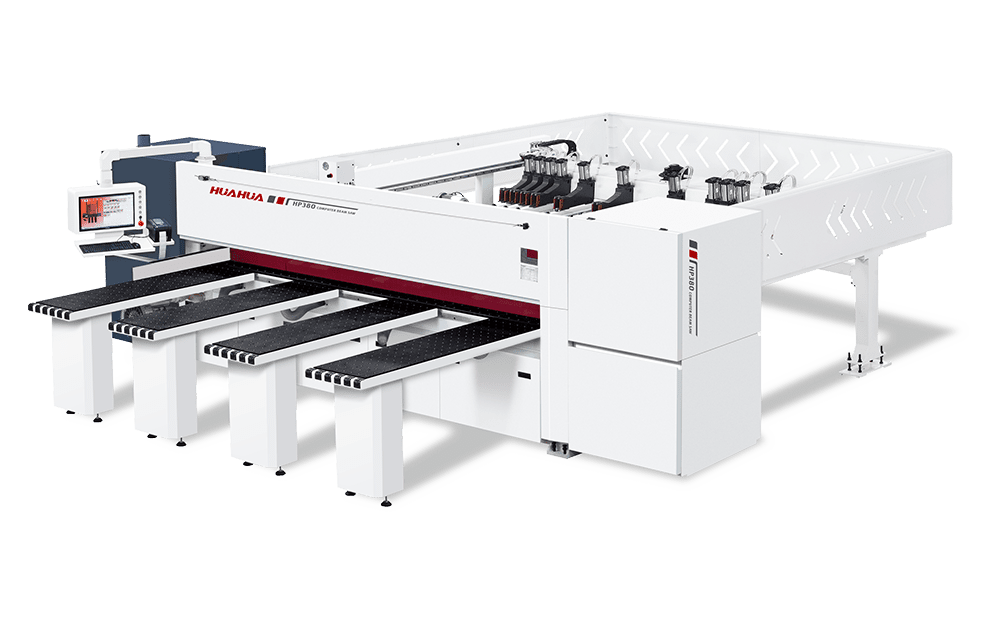
Evaluate vendors on three concrete dimensions: mean time between failures, spare-part lead time, and ease of software updates. Compare a beam saw and a panel saw by checking their cutting accuracy under load and the accessibility of consumables. Look for machines that provide diagnostic logs and clear fault codes. Visit local installations if possible—seeing similar operations in Guangdong or nearby industrial clusters will reveal how a model performs under real conditions.
How to measure success and adjust
Track these metrics: on-time delivery rate, scrap per shift, and machine utilization. Use weekly reviews to adjust nesting parameters, blade choices, or program sequences. When a trend shows rising scrap, act immediately—often it’s either a worn blade or a change in material thickness that wasn’t recorded. Small, frequent adjustments keep processes stable and morale high.
Vendor selection and team adoption
Pick a supplier that offers clear training, local service, and accessible parts. During acceptance, insist on a supervised production run that mirrors your typical order mix. Train three team members to prevent single-person knowledge risks. Encourage operators to suggest tweaks; they will spot practical improvements a planner misses—this buy-in makes integration stick.
Three golden rules for selection and deployment
1) Prioritize consistent cycle metrics: choose machines whose published feed rate and actual output align reliably. 2) Require transparent diagnostics: pick systems that report errors and log run data for troubleshooting. 3) Insist on local service and short spare-part lead times so repairs don’t stall production. These rules protect throughput and simplify daily decisions.
Putting these principles into place turns a risky investment into a steady advantage; it helps teams produce more with less friction and prepares regional workshops for predictable growth. HUAHUA CNC often proves the practical partner when you want machines, training, and service that match real shop demands — clear, direct support that keeps the shop moving. —