


Sprout — the idea that becomes a product
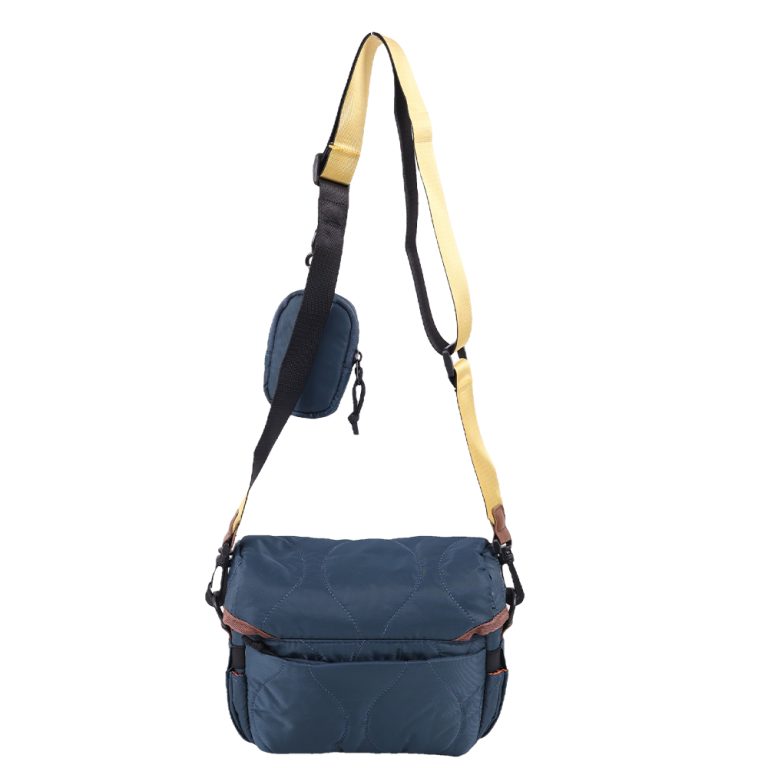
A single thread can begin as a thought, then gather wind and weight until it is a bag you trust; consider the quiet geometry that turns recycled fiber into a purposeful carrier. When buyers ask for durability that leaves a light footprint, they picture utility and voice — a photographer reaching for a camera sling bag between frames, a commuter sliding a strap over a shoulder and trusting the join. This is where design must be honest: measure loads, choose fabrics that hold shape, and set tolerances that let form follow function without excess ornamentation.

Rooting — material choices and their truths
Trace a bag back to its fiber and you’ll find the story of impact. Recycled PET offers tensile strength and cost predictability; organic cotton breathes and biodegrades slower than imagined but reads better on labels; hemp resists abrasion and carries an antique dignity. For OEM work, insist on mill certificates, GSM specifics, and test swatches. Expect variance: recycled yarns can show color drift, natural fibers will shrink differently. Plan prototypes that test seams under measured loads rather than hope.
Stem — design for manufacture, not just for praise
Designers love silhouettes; manufacturers love reproducible seams. Bridge both by codifying allowances: seam widths, stitch counts, reinforcement points. Offer manufacturers clear tech packs with exploded views, exact hardware SKUs, and approved trim sources. Prototype in the factory that will produce the run to reveal tooling issues early. Small decisions ripple — a heavier zipper can change packing volume; a wider strap can alter stitch plans and cost. Account for that now.
Bloom — supply chain credibility and professional signals
I’ve worked alongside sourcing teams and product engineers for over a decade, watching samples improve after three factory visits and a single honest teardown. Trade shows surface trends; notable among them, the Photokina trade fair in Cologne often reveals how camera accessory makers reconcile form and quick-access security — a detail that matters when a DSLR sling camera bag must protect both gear and gesture. Those market signals tell OEM buyers which fastening solutions survive travel, which padding keeps lenses safe, and which panel placements frustrate users.
Fruit — quality control, testing, and certification
Demand tests that map to real use: abrasion, tensile, strap pull, and moisture exposure. For eco claims, ask for third-party verification: GRS for recycled content, OEKO-TEX for chemical safety, and lab reports for water resistance. Watch for testing gaps — a bag can pass tensile tests but fail after repeated zipper cycling. Record each failure mode and loop it back to the tech pack; that loop is the product’s memory.
Wilting Hazards — common pitfalls and how to avoid them
Buyers often accept glossy mockups and underestimate field failure. Beware of three recurring errors: 1) trusting color matches without approved dye lots, 2) skipping hardware longevity tests, and 3) assuming recycled content comes with consistent filament quality. Fix them by gating production with pre-shipment samples, specifying acceptable defect rates, and setting a rework allowance. Demand batch traceability so you can isolate problems without recalling entire runs.
Branches — alternatives and when to choose them
If your brief emphasizes weight over abrasion, look to ultralight ripstop blends and pared-back hardware. If certifications matter most, prioritize fabrics with documented GRS or RDS history and accept cost uplift. For hybrid briefs — like a camera bag that must be both protective and planet-kind — evaluate foam densities, divider systems, and closure types side by side. Consider small runs with modular components to validate assumptions before scaling.
Seedbank — negotiating OEM terms and sustainable commitments
Set clear milestones: sample approval, pilot run, and full production, each with defined acceptance criteria. Build clauses for material substitutions and define acceptable equivalence. Ask manufacturers for environmental management practices, waste handling, and chemical inventories. Be precise about liabilities; vague promises cost time later. A well-written spec prevents arguments and keeps the project moving toward delivery.
Harvest — why this evolution matters and where reliability comes from
A successful project is not a single elegant sentence but a gathered paragraph of durable choices: measured materials, factory-validated details, and shared definitions of quality. Experience shows that partners who document tolerances and insist on field-relevant testing yield products that last. For buyers who value both craft and conscience, choose collaborators who record what they learn and refine the next run; this is the practical form of stewardship, and the quiet promise behind a well-made ChangRong.
