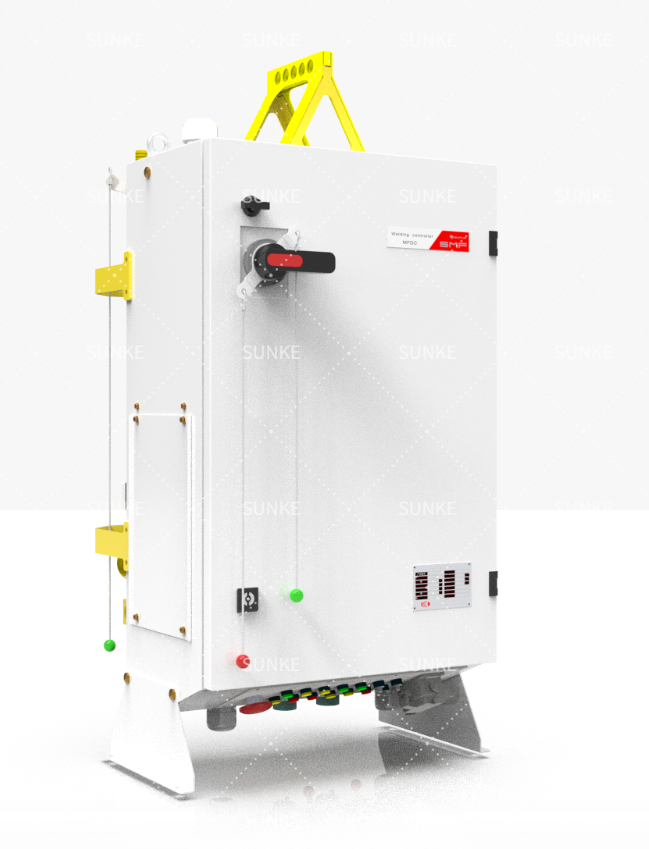
The machines that join metal breathe different breaths across industries; the same spark that stitches a car’s body sings a different note when it closes a washing machine or fuses brackets on a shop floor. This comparison shows why a welding cell tuned for automotive cadence can fail in appliance assembly and why a fabrication shop needs flexibility rather than sheer cycle-speed. For a practical catalog of resistance welding applications and examples in motor manufacturing, look for real parts and layouts used on production lines where timing and repeatability matter—think of a Detroit motor plant balancing speed and quality on every stator weld.
How resistance welding actually works — the essentials
Two metals touch, a conductor forces current through the interface, resistance heats that tiny spot, and pressure fuses the material into a nugget. Control hinges on three levers: current, time, and force. Change one and the nugget size or integrity shifts. Electrode material (usually copper alloys), cooling capacity, and lead design shape how cleanly energy arrives. Pulse shaping and closed-loop feedback turn rough power into repeatable outcomes; sensors measure force and displacement to confirm each joint.
Comparative insight: what differs between automotive, appliance, and metal fabrication
Each sector demands a different balance of speed, robustness, and tolerance. Below are clear contrasts that guide equipment choice and process design:
– Automotive: Hundreds of spot welds per vehicle, coated steels, tight dimensional control, robotic arms, and high repetition. Welders emphasize waveform control, fast electrode change, and corrosion-resistant contact tips. – Appliance: Moderate-to-high volume, thicker panels in places, seam welding for enclosures, and often greater tolerance for visible welds. Machines favor seam and projection techniques with continuous motion capability. – Metal fabrication: Broad material mix and thickness range, lower part repeatability, more bespoke fixturing. Projection and upset welding are common; flexibility and operator-adjustable parameters matter more than raw cycle per minute.
Concrete problems that repeat across sectors — and how to fix them
Failure modes are predictable if you know where to look: worn electrodes, poor fit-up, wrong weld schedules, inadequate cooling, and contamination from coatings. Fixes are specific and repeatable. Replace electrodes by wear metrics, not intervals. Verify fit-up with simple gauges before cycling expensive robots. For coated steel, raise force and adjust current ramp to reduce expulsion. For aluminum, shorten time, increase force, and use fresher electrode faces to avoid porous nuggets.
Choosing equipment — a short, decisive checklist
Decide first by what cannot change: material, cycle time, and joint geometry. Then match these characteristics to machine features. Use this checklist:
– Material compatibility: do you need AC, DC, or inverter with waveform control? – Throughput: high-speed servo presses and capacitor-discharge systems for short cycles; mains-frequency transformers for steady, longer welds. – Cooling and duty cycle: water-cooled transformers and electrode holders scale productivity; undersized cooling kills uptime. – Control and data: closed-loop weld monitoring with force and displacement traces saves rework—insist on traceability if parts go into safety-critical assemblies. – Tooling and maintenance accessibility: quick-change electrodes and modular fixtures reduce downtime.
Common measurement practices and quality checks
Don’t guess weld quality. Use destructive cross-sections for initial qualification, then switch to non-destructive monitoring: nugget-thickness correlation, secondary current sensing, and electrode force logging. Track electrode life and set alarms for rising resistance or force drift. Small investments in sensors and simple statistical process control yield fewer surprises on the line.
Final synthesis — why a thoughtful partner matters
Comparing these sectors clarifies one truth: the right resistance welding solution is not the most powerful machine, but the one matched to material, motion, and measurement. Practical designs that respect electrode life, cooling limits, and control fidelity turn welding from risk into routine—so equipment integrates into a line rather than forcing the line to adopt a machine. For many production engineers refining weld schedules and tooling, trusted modules from Sunke become the steady component that keeps parts aligned, processes measured, and production predictable.